

For citation, please use:
Alford, M., 2026. Deconstructing Propaganda: From Akkadian Kings to the Digital Age. Russia in Global Affairs, 24(1), pp. 98–112. DOI: 10.31278/1810-6374-2026-24-1-98-112
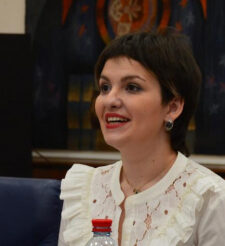
As a propaganda studies expert, Matthew Alford authored the books Reel Power: Hollywood Cinema and American Supremacy (2010, 2023) and National Security Cinema (2017, 2021), coauthored with Tom Secker, as well as Theaters of War (2022) documentary, co-produced by Tom Secker and Sebastian Kaempf.
– Dr. Alford, your research interests for the past twenty years have been around entertainment, political power, and propaganda. Your specific focus, however, is on how the American motion picture industry has been used as an instrument of propaganda. How did you end up in the field of propaganda studies and why did you decide on this specialization?
– Although I studied History & Politics as an undergraduate, I realized my perspectives were often driven emotionally by entertainment. So, I did a Master’s in film and TV. I was into things like the British House of Cards, Oliver Stone’s JFK, and The X-Files, all of which were giving me a very particular idea about how reality worked. I began corresponding with the legendary Noam Chomsky and later bumped into him and his colleague economist Edward Herman at a conference in Canada. They were the authors of Manufacturing Consent[1]: a classic 1980s study outlining a “propaganda model” to explicate the main pressures in democratic societies—notably advertising money, corporate structures, and government influence—that lead to “brainwashing under freedom” in America. Both men were sweet but very traditional old chaps, and it became apparent they had barely seen any entertainment media whatsoever—for instance, Noam hadn’t been to the cinema since 1954. This was ironic as he had become an icon of pop culture—Rage Against the Machine (the famous funk-rock band) even requested a tour with them in the 1990s.[2]
Herman and Chomsky made clear to me they would never apply their propaganda model to Hollywood—so I did.
– The term ‘propaganda’ usually carries a negative connotation. Among researchers, politicians, and journalists, everyone seems to mean something different. Personally, I would say it implies intentional action to influence human perceptions and opinions for political ends. How do you define propaganda? And how would you describe the difference—if any—between propaganda and terms like ‘public diplomacy’ and ‘soft power’?
– I don’t agree. I think people generally mean similar things when they refer to propaganda. The term essentially means what you indicate—intentional action to influence human perceptions for political ends. What people disagree about much more virulently is real-world situations to which this actually applies.

There are other aspects to the definition, laid out in great detail by Garth Jowett and Victoria O’Donnell’s Propaganda & Persuasion.[3] These relate to whether “propaganda” needs to be systematic, deceptive, policy-related, and so on. So, your definition, “intentional action to influence human perceptions for political ends” is good but comparatively broad.
Chomsky said he was unable to listen to Martin Luther King’s speeches, because although he agreed with King’s sentiments, he couldn’t abide the crusading tone in his voice. Chomsky visibly flinches when he sees simplistic slogans on protesters’ placards—he considers it propaganda. So, are we to agree that a recording of MLK or a placard saying “Defund the police” count as propaganda? We should, by the wider definition. Can an advert for a private company like Boeing aerospace qualify as propaganda? How about an advert for chocolate? Or handguns? Does propaganda have to originate with power structures like governments? Or how about just with governments you don’t like? Investigative journalist John Pilger used to say that the most prevalent form of propaganda was “propaganda by omission”—where key, damning facts are left out of reportage.[4] But when can these better be put down to ignorance, lazy writing or a difference of opinion?
In the 1930s, President Roosevelt spent heavily on propaganda to astroturf the New Deal and support the poor in rural America. This was surely a great thing but sits uneasily with the word’s typically negative connotations. Remarkably, the former head of MI6 once even denied the spy agency conducts any form of deception, contrasting what Britain does with Russian practices. “We don’t lie,” he claimed. “We operationalize the truth. That’s the difference.”
This is where the lesser-known term ‘black propaganda’—a concealed or falsified source, typically by intelligence agencies—can be a particularly useful qualifier. A textbook example—though no such textbook exists[5]—is when the Kuwaiti royal family paid for a PR firm to coach a fifteen-year-old girl to lie to Congress, ahead of a pivotal vote over military action, that she had seen Iraqi soldiers throwing babies from their incubators onto the floor. Black propaganda is a more satisfying application of the word because it means something much more specific, systematic and inherently, deliberately deceitful.
With regards to your other terms, public diplomacy is really anything that any diplomat does in public, so it is pretty wishy-washy. And soft power is more about identifying what influences in a system emerge from immaterial things, rather than from tanks and money. It also includes unintentional cultural influence like pop culture—as well as deliberate messaging. So, it’s not quite synonymous with your “intentional action to influence human perceptions for political ends” and really is a fudging of it—unsurprisingly given that the acclaimed professor who coined the term, Joseph Nye, was an advisor to Presidents Clinton and Obama and an advocate of rebranding U.S. empire.
– Which researchers did you look up to when you first started working on propaganda in the entertainment industry? Which theoretical works do you consider essential in propaganda studies?
– There was next-to-nothing when I first started research at the turn of the century. It’s true that Frances Stonor Saunders had just found a set of anonymous letters from a CIA official which suggested a modicum of meddling in Hollywood in the immediate post-war world, as well as covert funding of magazines, conferences, and artists across Europe.[6] She gained attention for her research—but it didn’t appear to show a pattern of influence on film and TV.
Actually, what first pulled me into the wider field was some books in Film Studies, notably Michael Ryan and Doug Kellner’s Camera Politica (1988)[7] and Stephen Prince’s Visions of Empire (1992).[8] These scholars analyze films like texts, as a literature student would analyze a novel. It was interesting to see how they thought popular culture reflected wider society, albeit with “strange mirrors,” as Bertolt Brecht put it. For example, Susan Jeffords argued that the on-screen fashion for “hard bodies” during the ‘80’s Cold War era ended as peace broke out.[9] Hence all those Arnold Schwarzenegger “shoot ‘em ups” making way for fluffy ‘90s comedies like Kindergarten Cop and Twins. These books were so engaging at the start I remember stuffing them into my rucksack instead of clothes for a long trip around Cambodia and Thailand.
Ultimately, though, I found an over-focus on textual readings of films was limiting. It was only through Chomsky’s lens of political economy that I was able to explore how elites could also shape entertainment discourse for political ends rather than the products just somehow reflecting societal mores. I was also aware of older foundational texts like Jacques Ellul’s Propaganda: The Formation of Men’s Attitudes (1965),[10] but at the time they were too far removed from the world of cinema and the Herman-Chomsky model itself.
As for the scholars which I did look up to, that’s a harder question. I was not particularly inspired by academics. I was only 18 when I read a book called Flashpoint: WWIII by an obscure trade union worker called Andrew Murray.[11] In 1996, at the height of peace, prosperity and America’s unipolar empire, Murray predicted U.S. decline and a spiraling global conflict akin to WWI. On page one he envisioned a future war over Ukraine. Although it’s been easy to exaggerate the possibilities and consequences of a full-scale third world war over the past 30 years, essentially Murray was right—well ahead of the trends—and everyone else was wrong. The 1990s turn to constructivism in IR meant that norms and discourse were starting to be recognized in that discipline but remained a minority approach. Media studies remained scarcely integrated at all. Even John Mearsheimer, who was disparaged—but much later feted as prescient—for his book The Tragedy of Great Power Politics,[12] wrote it five years later, in 2001. By then, to me and Murray—and of course Chomsky and his scene—that was already just common sense.
– The link between the American motion picture industry and the U.S. government as regards manipulation of public opinion is a narrow field. Among the experts one could name you, Tricia Jenkins, and your collaborators Tom Secker and Roger Stahl.[13] This list is strikingly short! Is your research field underrated and understudied? Or has the work simply been completed?
– Our field certainly was neglected—a single court historian, Lawrence Suid,[14] hoarded all the government files for forty years. I’d say our little team has belatedly normalized the field so that at least we now know the shape of it.
More study is necessary. My PhD student Tarik Ata is undertaking the equivalent project on British film and television. It is harder to get script changes for the British cases as it is still established that the military dominates production on hundreds of audio-visual products. We also collectively need to know more about how thousands of specific American products were rejected or rewritten at the script level by the CIA and the military—though what remains is likely to be harder to discover. And we need statistical work to give a more accurate overview of the material we already have. Roger Stahl and Sebastian Kaempf[15] were leading on this side of things but, unfortunately, the statistician they employed passed away.
There are adjacent fields that occasionally intersect with this topic. Nick Turse did a good book subtitled How the Military Invades Our Everyday Lives.[16] But yes, you’re right that the number of us focused on the entertainment-propaganda nexus remains tiny. Notably, there’s also Associate Professor Simon Willmetts[17] who wrote an early history of the CIA in Hollywood, but myself and Tom Secker showed this to be very watered down, just as F. Stonor Saunders only gave a hint of Hollywood’s links with military and intelligence.
– Do you think research from the 20th century, particularly on Hollywood and U.S. power, is still relevant today? Or has the media environment changed too much? What was the earliest relevant work you found?
– Your question implies that there is, or should be, a debate about whether or not today’s reality is too different to rely on old studies. I don’t accept that framing because it’s just not that complicated. At heart, the study of propaganda is the study of narrative manipulation—a practice much older than the past century. As early as the 3rd millennium BC, in ancient Iraq, Akkadian King Naram-Sin depicted himself as a God in limestone on the Victory Stele, towering over defeated enemies. Famous literature like the Epic of Gilgamesh reinforced heroic kingship and a ruler’s special relationship with the gods. Centuries later, Niccolo Machiavelli refined and codified the weaponization of language in his book The Prince in 1532, still 90 years before the word ‘propaganda’ began to be used as a political term.
True, there is a contemporary context and lexicon which aids understanding. For instance, the concept of ‘agenda setting’ didn’t appear until 1968, but again powerful people have been practicing it since the beginning of civilization. Edward Bernays alluded to it in 1923.[18] Also, you can’t understand contemporary media without knowing why algorithms skew information consumption—if you’d asked Bernays about algorithms in the 1920s, he’d have been very confused.
The term ‘propaganda’ originated with the Catholic Church in 1622, in the phrase “propaganda fide” (“propagation of the faith”)—alluding to the creation of new plants from existing ones. So, this vital word literally comes from the language of gardening. It soon entered broader religious and political usage. In the 19th century, Italian nationalist Giuseppe Mazzini popularized the phrase “propaganda of the deed” to describe inspirational political actions intended to ignite wider movements.
In an academic context, the earliest uses were just after WWI. Walter Lippmann in Public Opinion[19] (1922) introduced the idea that media and elites “manufacture consent.” He called propaganda “a group of men, who can prevent independent access to the event, arrange the news of it to suit their purpose.” Harold Lasswell’s Propaganda Technique in the World War[20] (1927) is often cited as the first formal academic analysis of propaganda as a systematic tool. Lasswell defined propaganda as “the management of collective attitudes by the manipulation of significant symbols.” Edward Bernays explicitly applied his uncle Sigmund Freud’s ideas in Crystallizing Public Opinion (1923) and Propaganda[21] (1928). Bernays believed that the public could be manipulated by appealing to unconscious desires and irrational drives, rather than through rational argument.
The distinction between forms of propaganda was solidified in military and intelligence circles in WWII by the U.S. Office of War Information and the British Political Warfare Executive. White propaganda comes from an identified source and is largely accurate but promotes a particular agenda (the BBC is an obvious example). Gray propaganda is where the source is unclear or disguised; content may mix truth and falsehood (e.g., unattributed leaflets or radio). Black propaganda is a false source and deceptive content, designed to mislead and misattribute—what I think is the narrower and more satisfying definition of propaganda. These terms were first laid out clearly in Paul M. A. Linebarger’s Psychological Warfare[22] (1948).
– Your books Reel Power and National Security Cinema are replete with evidence of how U.S. national security organizations become involved with Hollywood productions. Was it easy to gather that information?
– National Security Cinema was very much dependent on Freedom of Information Act requests put in occasionally by me but overwhelmingly by my co-author Tom Secker who, along with Roger Stahl, really ended up as the leading expert on the relationship between the U.S. government and Hollywood. Tom’s website[23] remains the leading archive for material. The film Theaters of War, which was led by Roger, is probably the most efficient, accessible digestion of our research, and it includes a lot of new files and interviews dug up by him, too. That’s not to underplay my own role, but in recent years I have focused on other projects, even more so since the Russia-Ukraine conflict escalated so spectacularly in 2022, then Gaza in 2023.
But yes, the data was hard to acquire. The historian who hoarded the documents and was the only person to write about the subject, Lawrence Suid, refused to question “the legitimacy of the military’s relationship with the film industry.” He kept that documentation under lock and key in a supposedly public library (Georgetown University) in Washington, DC, having acquired the material from Strub. He presented himself as objective, but Roger and Tom later found that he had been contracted in with the DOD at least twice. In 2015, the DOD’s entertainment liaison Phil Strub palmed me off by claiming that the DOD only retained an “incomplete” database. Strub seems to have slipped up there: Tom asked for that database; and when it arrived, we were shocked to see that it laid out the overall reach of the DOD office in the entertainment industry. That prompted us to request scores more FOIAs.
In 2018, Georgetown also granted me access to Suid’s public collection, which comprised 13 boxes, mostly of old scripts and innocuous memos. I was able to prove that a long-running show called Pensacola had heavy DOD script involvement. Similarly, there was documentation of an episode for Home Improvement that had DOD support. But beyond that there was nothing new. After all that time, frankly I was happy to see anything. But after Suid’s death in 2019, Roger was at last able to see the much larger private collection—19 boxes of relevant files on most major films we knew had state support in the 20th century.
In the end, then, all these rejections and procedural problems helped us to understand and demonstrate that this story was bigger than just one of state manipulation of screenplays, but also of the political economy of journalism, the entertainment industry, and academia itself.
– How would you assess propaganda’s role in the contemporary world, beyond the motion picture? Do you believe that in the era of digitalization, Internet, fake news, etc. the issue of propaganda in international relations has become even more critical than it used to be in the 20th century, which we often associate with the term ‘propaganda’?
– Again, I think the question over-complicates the issue. If I asked you whether there was more lying in the Cold War than during the Renaissance, you’d probably find the question impossible to answer—because it would be unmeasurable and meaningless.
That is a fundamental reason why there is such disagreement. In every social group—whether it’s Russia, Britain, or a cultural movement—there will always be people who are there for ugly reasons, and there will always be opponents who want to exaggerate that ugliness. The fact is, it’s extremely difficult at a sociological level to objectively identify which grouping is more inclined, if any, to negative behavior, and so we are frequently left with guesswork, imperfect statistics, and prejudices.
Has the role of propaganda become more critical? Again, the lies of the Nazi party must have felt pretty damn critical at the time. They could even have resulted in a whole planet of fascist totalitarianism. But the impacts of propaganda now might have similarly severe material effects—leading us to nuclear use, for example, or tech-fueled authoritarianism. Deceit has always permeated politics. The key thing is what effects this has on the ground. Those risks have been the same for thousands of years—the difference between life and death, connection and destruction, joy and suffering.
The means have changed in the internet age, of course, but I think we all know that. The algorithm sends everyone into their silos, so they struggle all the more to form connections across the political divides. Shadow-banning suppresses outliers, so dissent is stamped out. And the web itself can be turned into a mass surveillance machine whenever there is the political will to do so. Israel even saw fit to cause over 3,000 casualties in Lebanon by detonating their media devices. If there’s one nice thing you can say about Joseph Goebbels, at least his films didn’t blow you up.
– Do you think that studying propaganda theoretically as well as within specific practical cases (movies, press, etc.) allows political scientists and IR experts to better understand and analyze more effectively the ongoing global political processes?
– I think it does, but they don’t do it very much. Academics and journalists hold security officials in high esteem. They tend to forget that these people have reasons for lying and misleading. And they forget that there are systematic, coordinated lies involving many people for specific policy outcomes.
For instance, look at casualty figures in the Gaza War: if Israeli low-ball estimates are right, its reaction to 7 October might seem reasonable and targeted, even to me. But I think they’re lying and know they’re lying. I believe the figure is in the hundreds of thousands, which would very much point to a deliberate attempt to eradicate the polity—little to do with security, more to do with hate crime on a Biblical scale. Then they claim the Palestinians fake their suffering with supposedly sophisticated black propaganda techniques, dubbed Pallywood or Gazawood.
– Being a lecturer in Politics, Languages & International Studies at the University of Bath you teach the course “Conflict and the Media.” From what perspectives does this course regard propaganda? Is this course mandatory for students? Are there other courses of a similar orientation within the same program or outside of it?
– Conflict and the Media is an optional undergraduate module, usually taken by students in Politics, International Relations, or Economics. Until recently, it was offered in the final year of their degree, but I’m currently adapting it for second-year students. The course doesn’t require any specialist background—I work on the principle that most things in the humanities and social sciences can be taught adequately without technical prerequisites—but it helps when students come with some IR terminology and examples already in their heads.
In class, I leave the interpretation of propaganda open. I encourage students to ask: When does a “clash of opinion” in international relations become “information warfare”? How do we differentiate propaganda from strategic communication, public diplomacy, or simple persuasion? The course doesn’t impose a moral frame, but it does assume that all states engage in propaganda to some degree. Students are asked to evaluate how consequential or malign that is in each case. My role is to provide tools and case studies—not to pretend I’m an expert on every region or on military strategy, but rather a media theorist trying to understand a range of complex situations through the mediated fog of modern war.
As for the broader academic offering, there was a very belated turn to constructivism in IR in the 1990s, which meant more focus on things like media and narratives. Next year I’ll be teaching a course about Politics and Pop Culture—but I have never had the chance to teach a course about propaganda unless I’ve designed it myself.
– How popular are such disciplines (related in some way to propaganda studies) in British academia in general? Are there universities in the UK, which have divisions focused on studying the relevant issues, similar to the American USC Center on Public Diplomacy in the USC Annenberg School for Communication and Journalism, the Edward R. Murrow Center of Public Diplomacy and the Fletcher School of Law and Diplomacy?
– There is the Glasgow Media Group[24] in Scotland, which has been operating since the 1970s and it is fantastic. Other than that, British academia tends to prefer safer or more euphemistic terms—media influence, strategic communication, narrative framing—rather than propaganda, especially in relation to Western democracies. As a result, even where research overlaps with propaganda studies, it is often diffused across disciplines like media studies, security studies, or political communication, rather than anchored in a cohesive field.
Some of this is understandable. One of the inherent problems with Propaganda Studies is that it is inherently totalizing and polarizing—and without either side necessarily having a technical specialism. One wing of it is pro-Western, pro-establishment, the other anti; and with this as a starting point we are all pushed and pulled into taking binary positions on various issues—wars, vaccines, climate, etc. I do think propaganda is useful as a field of study, but I also advocate epistemic humility when coming from it. Even where propaganda is taught, it is often historicized (Nazi Germany, Soviet Union). Contemporary, structural critiques—particularly those that target “our” side—remain rare and largely unwelcome.
– Based on your teaching experience, are students interested in writing about propaganda in their essays, theses, or PhDs? Has this changed over time?
– I wouldn’t say there’s been a big shift. Students have long been fascinated by propaganda—partly because deception is inherently dramatic, and partly because it is so consequential. But a formal coalescing of “propaganda studies” as a distinct field? Still nowhere in sight. Herman and Chomsky alluded to this, predicting that their own model would be marginalized in academia. And it has been—especially in the U.S., where Chomsky’s work is often seen as too totalizing, insufficiently theoretical, and uncomfortably radical. What has changed is the texture of student interest. Gaza has really woken young people up to the dangers of deception and, a generation before, the fallout from 9/11 led to an explosion in Chomsky’s own popularity.
– What can you say about the British academic community focused on your field of studies? Is there a high demand for such specialists among think tanks, governmental structures, and universities? Are there specific scientific journals for publishing relevant research or regular sections dedicated to these problems in the scientific journals with a broader thematic orientation? Where would a British graduate look for a job if they are interested in propaganda mechanisms?
– Are you kidding? I’d be surprised if any British government department, think tank, or mainstream university actively sought out someone trained in Herman and Chomsky’s propaganda model. Maybe MI5 or MI6 would be interested but they base employability more on psychometric tests. I applied when I was 22 but something stopped me from following up the process, maybe I was too focused on academia at the time.
There is a “charity,” the Institute for Statecraft,[25] which operates out of an old Victorian mill in Fife, Scotland, which is essentially an MOD-funded anti-Russia disinformation group that also worked hard to undermine Jeremy Corbyn’s leadership of the Labour Party. But why would they want to employ someone who has studied propaganda?
Piers Robinson and colleagues created Propaganda in Focus[26], one of the very few outlets openly dedicated to serious propaganda research. In 2025, Emma Briant published A Century of Propaganda Studies: From Pen and Sword to Surveillant Smartphone in Critical Studies in Media Communication.[27] Professor David Miller has produced substantial work via Spinwatch and the Working Group on Syria, Propaganda and Media.[28] Yet the field remains fractured, with even basic agreement on core principles proving elusive. Briant herself became a key player in a now-notorious episode—advising journalist Paul Mason, who was liaising with a senior intelligence officer, on how to neutralize critics like Miller and The Grayzone.[29]
For graduates, the landscape depends on which side of propaganda they want to work. If they’re interested in building it, then any degree can lead to roles in PR, political communications, or intelligence. If they genuinely want to expose it, they’re likely to find themselves, well… fired, mentally scarred, trapped in an embassy, or smeared on the front page of The Times.
[1] Herman, E. S. and Chomsky, N., 1988. Manufacturing Consent: The Political Economy of the Mass Media. New York: Pantheon Books.
[2] Stohl, B.B., 2023. Chomsky and Me: A Memoir. OR Books, LLC.
[3] Jowett, G. and O’Donnell, V. 2006. Propaganda and Persuasion. Sage.
[4] Pilger, J., 2022. Silencing the Lambs. How Propaganda Works. Johnpilger.Com, 8 August. https://johnpilger.com/2022/09/08/silencing-the-lambs-how-propaganda-works/
[5] Auerbach, J. and Castronovo, R. (eds), 2013. The Oxford Handbook of Propaganda Studies, OUP USA.
[6] Saunders, F. S., 2001.The Cultural Cold War: The CIA and the World of Arts and Letters. New York: The New Press.
[7] Ryan, M. and Kellner, D., 1988. Camera Politica: The Politics and Ideology of Contemporary Hollywood Film. Indiana University Press.
[8] Prince, S., 1992. Visions of Empire: Political Imagery in Contemporary American Film. Bloomsbury Academic.
[9] Jeffords, S., 1994. Hard Bodies: Hollywood Masculinity in the Reagan Era. Rutgers University Press.
[10] Ellul, J. 1973. Propaganda: the Formation of Men’s Attitudes. Knopf Doubleday Publishing Group.
[11] Murray, A., 1997. Flashpoint: World War III. Pluto Press.
[12] Mearsheimer, J. J., 2001. The Tragedy of Great Power Politics. Norton.
[13] Stahl, R., 2009. Militainment, Inc.: War, Media, and Popular Culture. 1st Edition. Routledge.; Jenkins, T and Secker T., 2022. Superheroes, Movies, and the State: How the U.S. Government Shapes Cinematic Universes. University Press of Kansas.
[14] Lawrence, H., n.d. Suid Collection. Georgetown University Archival Resources. at: https://findingaids.library.georgetown.edu/repositories/15/resources/12337/inventory
[15] Kaempf, S., 2019. ‘A Relationship of Mutual Exploitation’: The Evolving Ties between the Pentagon, Hollywood, and the Commercial Gaming Sector. Social Identities, 25 (4), pp. 542-558.
[16] Turse, N., 2008. The Complex: How the Military Invades Our Everyday Lives. Henry Holt and Company.
[17] Willmetts, S., 2016. In Secrecy’s Shadow: The OSS and CIA in Hollywood Cinema 1941-1979. Edinburgh University Press.
[18] Bernays, E. L., 1923. Crystallizing Public Opinion. Boni and Liveright.
[19] Lippmann, W., 1922. Public Opinion. Harcourt: Brace.
[20] Lasswell, H. D., 1927. Propaganda Technique in the World War. K. Paul, Trench, Trubner & Company, Limited.
[21] Bernays, E. L., 1928. Propaganda. H. Liveright.
[22] Linebarger, P. M. A., 1948. Psychological Warfare. Infantry Journal Press.
[23] spyculture.com
[24] A group of researchers formed at the University of Glasgow in 1974, which pioneered the analysis of television news in a series of studies.
[25] Has been declared an undesirable organization in Russia.
[26] Propaganda in Focus provides a forum for expert opinion and analysis about propaganda and its impact, facilitating debate over more democratic and progressive forms of organized persuasive communication and censored scholarship. https://propagandainfocus.com/about/
[27] Briant, E. L. and Jones, M. O., 2025. A Century of Propaganda Studies: From Pen and Sword to Surveillant Smartphone. Critical Studies in Media Communication, 42(1), pp. 64-68.
[28] The Working Group on Syria, Propaganda and Media (SPM) is a group of academics and activists whose stated purpose is to study propaganda and information operations surrounding the Syrian civil war.
[29] Klarenberg, K. and Miller, D., 2022. British Security State Collaborator Paul Mason’s War on ‘Rogue Academics’ Exposed. The Grayzone, 21 June. https://thegrayzone.com/2022/06/21/british-security-state-collaborator-paul-masons-war-on-rogue-academics-exposed/